A teleprompter for your desktop. Put a small reader next to your webcam and speak: Kalipso follows your voice with speech recognition that stays on your computer, scrolls at a steady pace, or waits for your pedal.
Linux, with versions for KDE Plasma and GNOME. Windows and macOS: experimental. No account, no cloud.
Opening remarksVoice following · demo
Thank you all for being here. [smile] Today I want to share one simple idea. A teleprompter should follow you, not the other way round. Speak at your own pace, pause when you need to, and pick up again. The line you are on stays right here, at the same height.
165 words/min
A demonstration of voice following: the current word is marked, words already said fade, and your line stays at the same height.
Three ways to keep your place
You speak. The script keeps up.
Follow your voice
Words you have said fade, and the line you are on stays at the same height. Recognition runs on your computer, with Moonshine or Vosk, or the system's own on Windows and macOS.
Arrow keys, a foot pedal, a presentation clicker or your phone. Each key can do what you choose.
Try the reader
See how your place is kept.
This is the reader from the app, in your browser. Advance a few words, change the colors or mirror it for teleprompter glass, then edit the script. The browser version never records audio or saves your script.
Sample script
A little preparation makes room for a better conversation. Take your time. Leave space for a pause.
Manual demo · Microphone off
Changes appear immediately. [Bracketed cues] are shown but never read. This demo resets on reload; the desktop apps save your script.
In real use
Right under your camera, on top of any app.
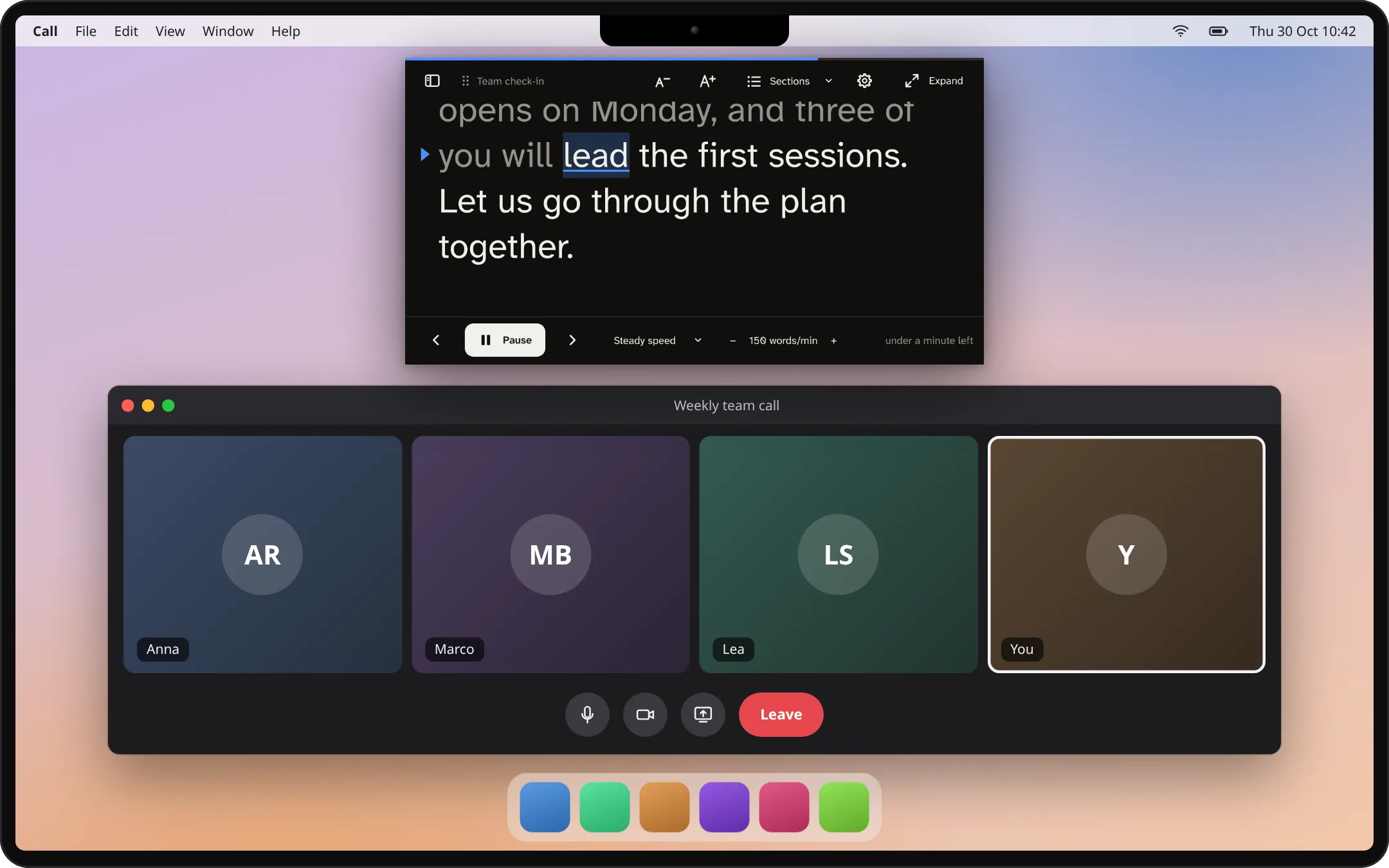
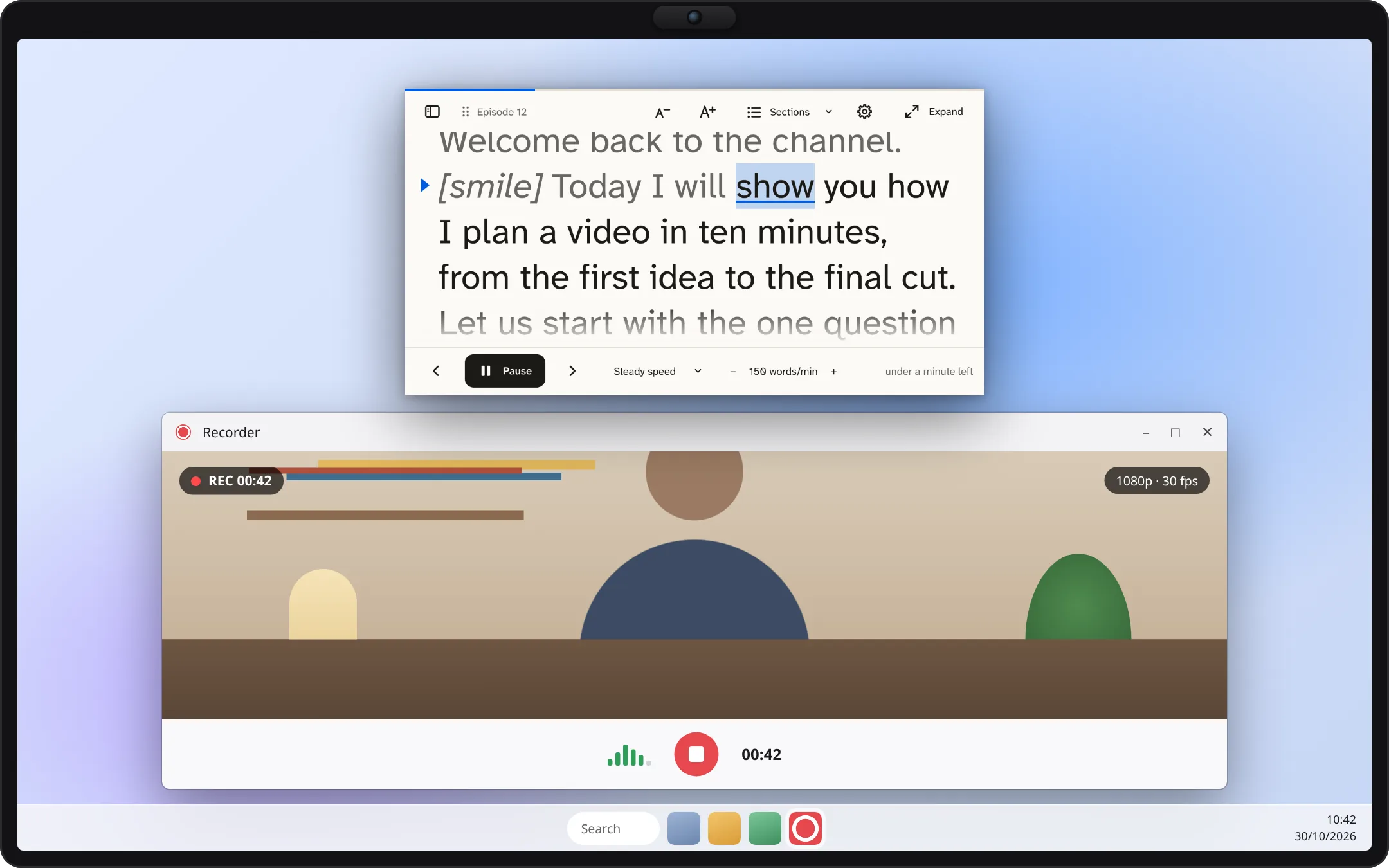
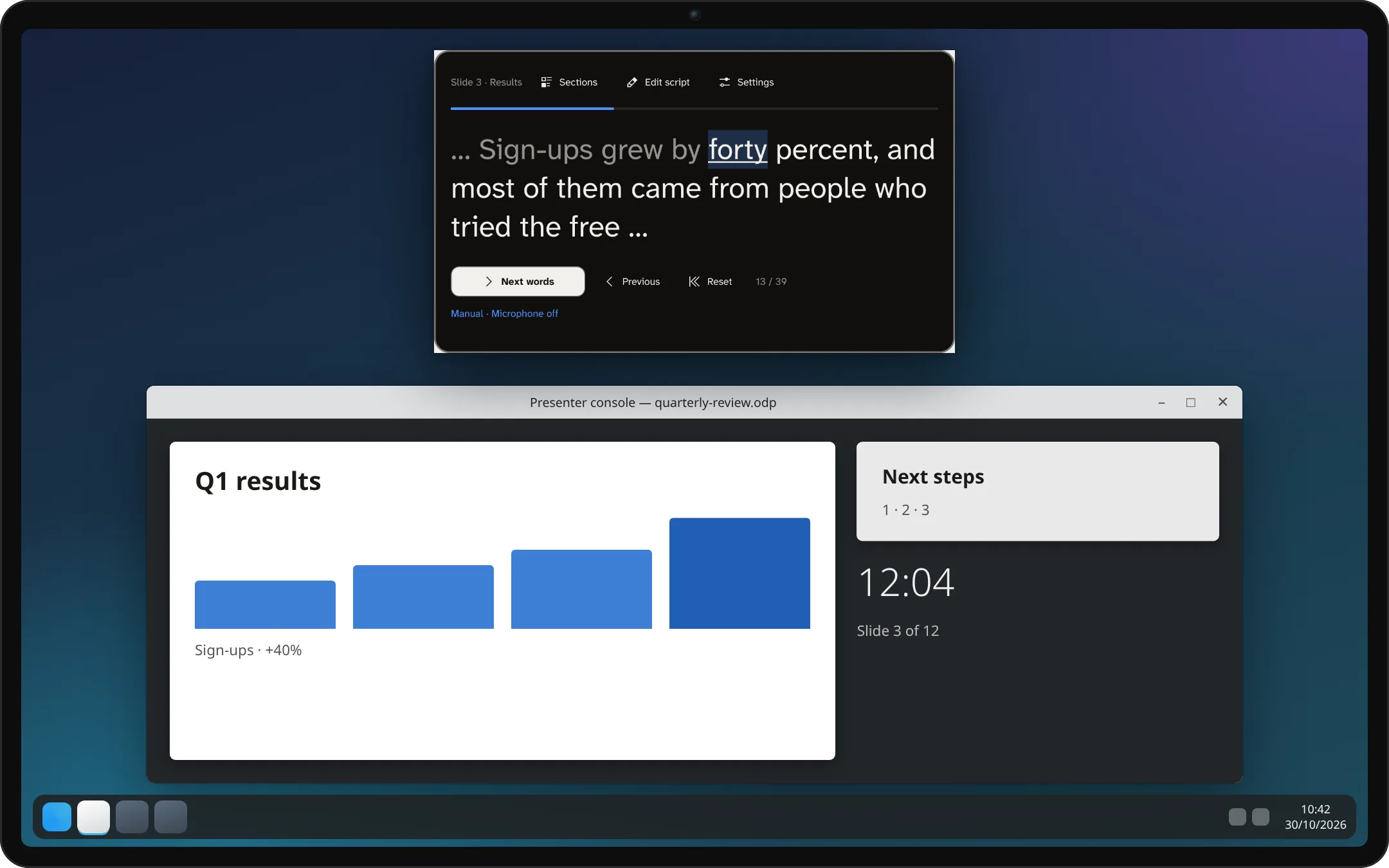
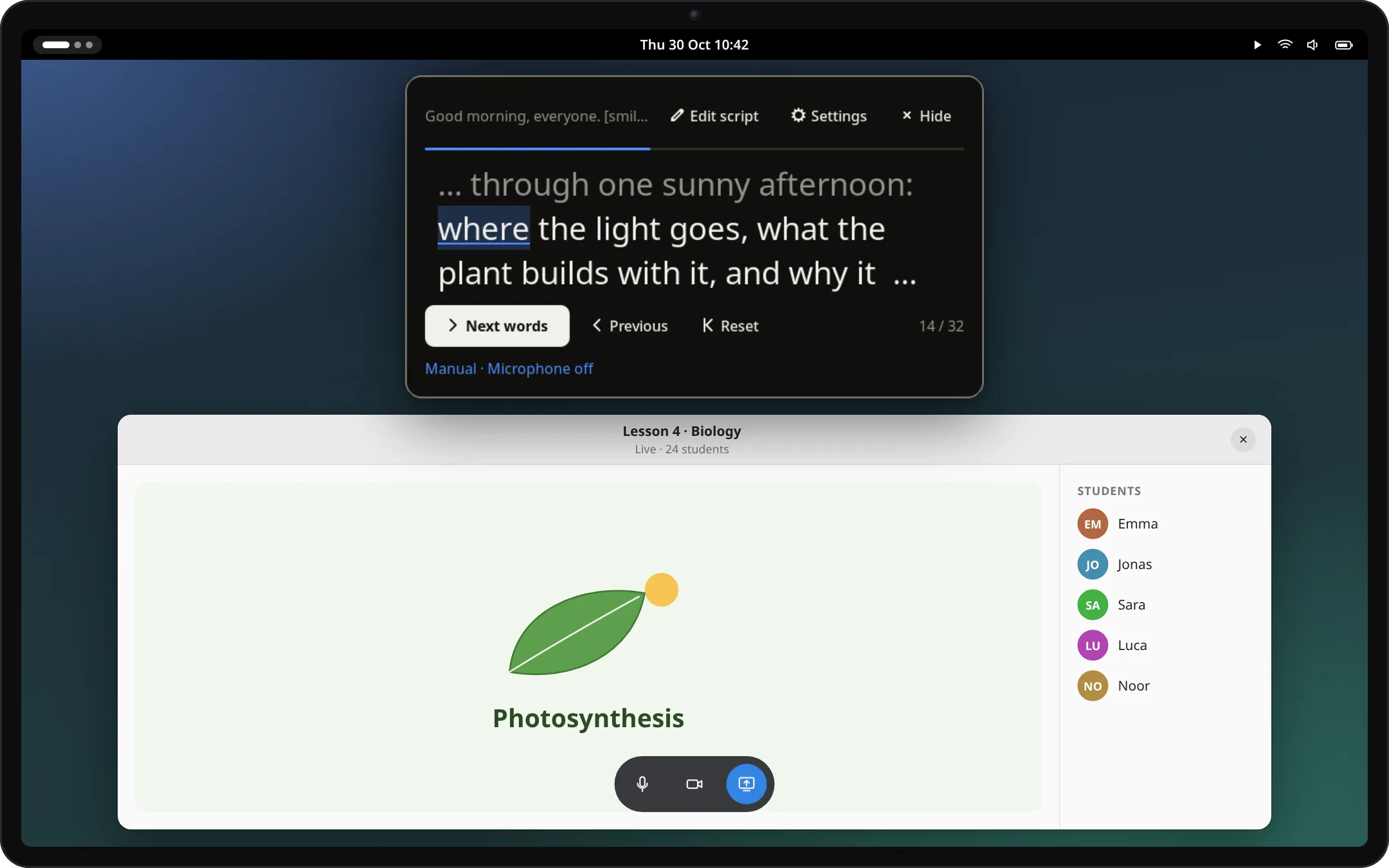
On a call, while recording, while presenting: the reader stays where your eyes should be, on Linux, Windows and macOS.
On a video call · macOSThe reader sits just under the camera, so you keep eye contact while you talk.Recording a video · WindowsSteady scrolling at your speed while you record, in light colors here.Presenting slides · KDE PlasmaThe Plasma widget keeps your notes, one section per slide; step with a clicker or the arrow keys.Teaching online · GNOMEThe GNOME extension opens from the top bar, on top of any app.
Simulated desktops and apps, drawn for illustration. The Kalipso windows in them are real captures of the current version.
Private by design
Your words stay on your computer.
No account, no cloud. Scripts are plain text files in a folder on your computer.
Speech recognition runs locally. Audio never leaves your computer and nothing is recorded.
The phone remote never sees your script. It only sends commands such as start, pause and step, over your own network.
SANSEVIERIA License 1.0. Read the code, build it yourself, check what it does.
What else it does
Made for the way you present.
Speaker notes and documents
Import notes from PowerPoint and Impress, one section per slide, or Word, Writer and Markdown documents.
Follows Impress live
Present with LibreOffice Impress and the reader jumps to the notes of the slide on screen. On Linux, Windows and macOS.
Mirror for glass
Flip the text horizontally or vertically for a beam-splitter teleprompter. The controls stay readable.
Easier reading
Larger or smaller text with A− and A+, any font you have, including ones made for dyslexia, wide line spacing and lines that fade at the edges.
Write where you read
One window: in a large one you write in the reader itself, with buttons for bold, italic, sections to jump to and [cues] like [smile] that are never read. Under the camera, it shows only the reader.
How it went
After a voice session: pace, long pauses and time per section, saved as a report if you want one.
Install
Get Kalipso 3.0.
Free packages for Linux, Windows and macOS on the release page. They are not signed yet, so your system asks you to confirm the first time; SHA256SUMS there lets you check each download.
Linux app
Arch and EndeavourOS · Debian 13, Ubuntu 24.04 or newer · Fedora
The full app: write and read in one window, a script library, imports, a movable and mirrorable reader, phone remote and voice following. Every package also brings the Plasma widget, the GNOME extension and the KWin script.
Arch Linux and EndeavourOS, ready to run (kalipso builds it on your computer):
yay -S kalipso-bin
Debian and Ubuntu, in the folder where you saved the .deb from the release page:
sudo apt install ./kalipso_*_amd64.deb
Fedora, in the folder where you saved the .rpm from the release page:
A reader on your desktop or panel, with the scripts you write in the app. It comes with every Linux package of the app; without the app, add the .plasmoid from the release page. Voice following needs the Kalipso companion.
A reader from the top bar, with the scripts you write in the app. It comes with every Linux package of the app: log out and back in, then turn it on in Kalipso's Settings. Without the app, install its .zip from the release page. It declares Shell 48 and 51, the versions it is tested with.
Apple Silicon · macOS 14.4 or later · experimental
The app, as a .dmg: open it and drag Kalipso to Applications. The first time, choose Open Anyway in System Settings → Privacy & Security. On-device system speech needs macOS 26.
The app, as an .msi installer or a portable .zip. If SmartScreen stops it, choose More info, then Run anyway. Voice following uses the speech recognizers installed in Windows.
Kalipso is a separate reading window; it does not need to be embedded in a particular meeting app. Window placement and capture behavior vary by desktop. Test your actual call or recording setup before relying on it.
Will others see it when I share my screen?
On Windows the app asks the system to leave the reader out of screen shares and recordings. On KDE Plasma 6.6 or later, the window is left out while it is under the camera. macOS offers no reliable way for an app to do this, so share a single window there. In every case, check the view from another participant, or the recorded video, before your presentation.
Can it read PowerPoint or Impress notes?
Yes. The standalone app imports the speaker notes of .pptx and .odp files, one section per slide. It can also follow a LibreOffice Impress slideshow while you present, moving to the notes of the slide on screen.
Which languages can it follow?
The download catalog has Moonshine models for English, German, Spanish, Japanese and Chinese, and Vosk models for those plus Italian. Recognition quality differs by language and model. Manual and steady reading work in any language. The interface is available in 39 languages.
Is my script saved automatically?
Yes. The standalone app, the Plasma widget and the GNOME extension save your script and reading position on your computer as you type. Nothing is uploaded. Only this browser demo resets when you reload it.
Is it ready for an important live presentation?
Kalipso 2.0 is the first public release. Recognition can still lose your place, and testing on real computers and microphones is still limited. Keep a copy of your notes, learn the manual controls and rehearse on your own hardware first.
Help make the next version better.
Tell us what worked, what did not, and what you need for your next talk or recording.